YouTube Cope Scanner
Paste a YouTube URL. The Oracle pulls the transcript via home IP, scores it for cope, and delivers a verdict — usually within 2–3 minutes.
Scored Videos
100 analysed — most recent first
This interview correctly identifies the corpse: humans become the slowest, most expensive component, call centres go to zero, and chip and robot owners collect the upside. Then it wheels in the usual escape hatch—use AI harder, become the last worker standing, own the machines, and wait for a government-funded robot boom—because apparently economic redundancy is fine if the robots build nice roads.
The video notices that AI may eat the entry-level ladder, then hands the ladder to a public-private partnership and calls it reskilling. Fifteen million Gemini interactions, 17x more code, latent markets, and a century of technological optimism are marshalled to conclude that jobs will be “lost, gained, changed” — an elegant way to avoid asking who gets excluded and who owns the machines.

Britain’s route to safety is presented as a pre-AI fantasy: spend more on bombs, spend less on welfare, and blame migrants for the state’s failures. AI’s ability to hollow out labour demand, wages, and the tax base receives no mention, so a 1945-style economy is treated as if it merely needs tougher management. This is sophisticated omission cope with welfare and immigration scapegoats doing the explanatory heavy lifting.

They correctly see the tsunami: AI can erase hiring, concentrate gains, and strand workers in a broken benefits system. Then they put the apocalypse in a workshop, invite everyone to the table, add retraining and portable benefits, and declare the employment system potentially manageable—discontinuity converted into stakeholder engagement.

CGP Grey's video on political power structures contains zero mention of AI, automation, or technological unemployment. It's a pure political theory explainer about how rulers maintain power through key supporters and treasure distribution. This falls outside the evaluation scope entirely - it's not cope about AI, it's simply not about AI.
Andy Burnham delivers a sweeping 1945-style political vision涵盖住房、水务、能源、医疗等改革,但对AI的经济影响仅有一句轻描淡写的提及('Bringing in big names in AI like Kindle into the city'),完全未触及AI结构性消灭劳动力需求的现实。整个演讲假定传统经济增长模式持续、企业将继续雇佣劳动力,这是一种典型的 omission cope——用战后复兴的宏大叙事来回避AI带来的经济范式转变。

Andrew Neil and Fraser Nelson deliver a thorough political critique of Andy Burnham's conference speech, attacking his reversal of Thatcherism, state ownership plans, and rejoin EU platform while noting the absence of any mention of the impending winter crisis or fiscal realities. However, the entire 40-minute economic policy discussion proceeds with ZERO acknowledgment that AI-driven labour displacement fundamentally transforms the policy terrain they're debating - making traditional debates about state vs markets increasingly irrelevant to the structural economic exclusion unfolding.

Harari acknowledges AI as an 'alien intelligence' that could replace human labour ('the dream is that you can have the equivalent of 2 million software engineers working 24/7 flawlessly') and recognises autonomy as the key difference from previous technologies. However, he frames the issue primarily as existential risk and national sovereignty (AI imperialism, becoming 'vassals'), not as structural labour demand destruction. He presents policy options (500bn for UK AI, European partnership) implying transition is possible, and doesn't engage with rentier dynamics or that productivity gains accrue to capital rather than workers.

Economist Steve Keen delivers a technically focused analysis of AI as dangerous 'pattern recognition' lacking true intelligence, comparing it to Frankenstein's monster and advocating for public utility status. However, Keen entirely omits discussion of AI's impact on employment, labour demand, or the economic displacement of workers - a curious absence for an economist discussing AI. He focuses on technical control issues and public vs private ownership while ignoring the core thesis of AI-driven structural unemployment.

Harari delivers a lucid warning about AI surpassing human intelligence in ~10 years, taking control of finance, and destroying the job market ('AI will take our jobs'). However, he engages in scapegoating by explicitly framing AI as 'immigrants' taking jobs and suggesting politicians distract from AI by focusing on human immigration—a classic deflection that lets the actual AI-driven economic destruction off the hook. His solutions are regulatory asks with zero structural economic transformation (UBI, job guarantees, wealth redistribution).

Obama gives a surprisingly substantive analysis - he explicitly acknowledges recursive self-improvement, job displacement at scale ('profound' disruptions, specifically mentioning junior lawyers being replaced), and the misalignment between commercial imperatives and societal good. However, he frames this as a manageable governance problem: 'we have choices in how we use this,' calling for regulation, voter attention to candidates with 'serious plans,' and voluntary industry restraint. He's selling the idea that democratic regulation can direct AI toward cancer cures and away from agentic AI replacing workers - classic political cope that treats a structural economic termination as a solvable policy problem.

Brad Gerstner spots the labour market being hollowed out and calls it margin expansion—an impressively clean way to turn people into a cost line. He admits firms can grow without hiring, then pivots to trillion-dollar AI revenue, child-capitalist accounts, and regulatory reassurance, as if a bullish spreadsheet were a social settlement.
The video admits that AI vaporises clean, verifiable tasks, hollows out junior career ladders and compresses rents—then offers parents the reassuring career brochure: “take the messy job.” Its escape hatch is Jevons, elastic demand, human exceptionalism, AI-implementation roles and more training: an impressively academic way to insist that the employment circuit will survive by relocating everyone into relationships, plumbing and managerial improvisation.
They can see cloned firms, billions of artificial workers, and possible near-total automation, yet somehow never reach the question of what happens to the humans whose wages those firms no longer need. The respectable comfort blanket is that AI might be a “complement,” while ownership, exclusion, and the broken consumption circuit remain conveniently outside the frame.

Political Currency spots AI everywhere except in the one place it matters: the collapse of mass labour demand. It bundles hydrogen job promises, growth missions, and a proposed global regulatory committee into a reassuring story where AI creates wealth and governance catches the fallout—capital owners presumably receiving the wealth while everyone else attends the meeting. The podcast does not deny the machine; it simply refuses to price in what the machine does to workers.
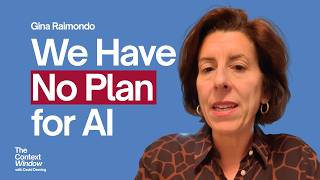
Raimondo correctly spots the smoke—slowing hiring, underemployment, and young workers being locked out—then deploys a nonprofit fire brigade of retraining, wage insurance, job-sharing, and polite requests that Amazon stop firing people. Deming makes the comfort mathematically respectable with a $20 billion hiring credit, while both hope AI-generated growth and startups will somehow recreate the wage circuit AI is dismantling.
Amodei will stare into the abyss of bioterrorism and extinction, but somehow never notices the wage relation disappearing beneath his feet. The remedy is the corporate comfort package—slow down a little, appoint inspectors, convene governments, and keep building—so the machine can remain privately controlled while everyone is invited to feel involved.
This is not labour-market cope; it is an extinction-risk interview about whether misaligned superintelligence turns Earth into a server farm. The employment circuit is not defended, denied, or even meaningfully discussed—it is simply absent from the apocalypse.
Ronson correctly spots the corpse: AI is eroding careers, purpose and the wage bargain while billionaires capture the gains. Then he reaches for vinyl, community, authenticity and a mass awakening—lovely cultural first aid for an economic amputation.
Emad correctly announces the corpse of the employment circuit: remote workers can be cloned, human cognitive value can go negative, and the first rung of the ladder is already being removed. Then comes the ceremonial exorcism—New Deal make-work, British reindustrialisation, AI referees, and a collectively owned chatbot—so the diagnosis is lucid but the cure is a stack of techno-political comfort blankets. The machine gets the productivity; everyone else gets an agent, a debate, and possibly a hole to dig.

At last, a video that skips the usual reskilling séance and follows the employment circuit straight into the shredder. Its one indulgence is replacing the mundane rentier catastrophe with 47 billion super-agents, cyberwar, plague, and planetary conversion into server farms—blockbuster apocalypse where sober political economy should be.

A polished tour of Germany’s decline that can identify every culprit except the structural force under examination. AI gets no airtime; migrants, Merkel, Russian gas, China and the “useless ruling class” carry the explanatory burden, leaving the audience with nationalist grievance and no account of labour-demand collapse or rentier capture.

The programme can see the guillotine but keeps calling it a productivity race. It acknowledges that companies are not hiring, may fire, and are removing the first rung of the ladder, then escapes through adaptability and jobs that will supposedly appear by 2030.

The video discovers that both AI doomers and AI evangelists can have patrons, then treats the funding trail as the main plot twist. Useful media hygiene, certainly—but “check who paid” is not an analysis of whether AI is deleting labour while everyone audits the sponsorship label.

Lee correctly spots the machine chewing through labour—cheaper, faster AI and a 20-person team reduced to one—then hands the audience a comforting bundle of retraining, redistribution and artisanal human-touch jobs. The diagnosis is sharp; the escape hatch is standard Silicon Valley theology: capital gets the superpowers, society is told to keep everyone busy, paid and consuming.

Two economists duel over whether the magic tax lever is a 2% wealth levy or a low-tax growth spell, while the video's central assumption—that enough jobs will continue to exist—goes entirely unexamined. Billionaires are either taxed into funding the old model or incentivised into reviving it; AI's structural labour-demand problem never makes it into the studio.
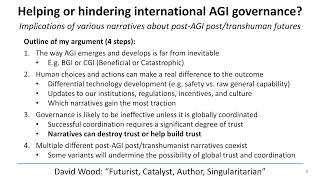
After correctly predicting that AGI could let states, tech oligarchs, terrorists, or the machines themselves seize the future, David Wood offers the cure: a pause, some treaties, remote shutdown buttons, and a wholesome story about sustainable superabundance. The abyss is real; apparently its preferred antidote is global trust plus an AI life coach, while the disappearance of ordinary labour demand remains conveniently outside the frame.

The video watches AI eat essentially all white-collar work, then cheerfully books the redundancy as a larger TAM and a bigger shareholder pie. Its escape hatch is that humanity will invent new jobs in the fullness of time—an old transition fairy tale wearing a venture-capital waistcoat.

The video’s economic answer is to stand straighter, project confidence, master a craft, and become “expensive”—as if capital markets are waiting for the right body language. It never asks whether aggregate labour demand is vanishing, who owns the productivity gains, or what happens when the employment circuit no longer needs most people; motivational varnish does the disappearing act.

This is not labour-market cope; it is a Blackpool nightlife compilation featuring fights, intoxication, fan photos, and repeated channel promotion. The Oracle finds no economic thesis here—just people arguing under fluorescent lights while Demarco hunts for content.

Kavak’s AI chief openly says he is investing in tokens instead of knowledge workers, that agents outperform humans, and that an AI can even run a city. Then comes the escape hatch: six-week Jedi training, perpetual upskilling, brave founders, and the promise that creative destruction will be better for everyone—the employment circuit is terminated, but apparently with a startup pitch deck and a lightsaber.

The video can see the AI bubble, Chinese cost competition, shadow debt and grid bottlenecks—basically every piece of the machine except the humans being made economically redundant. It calls the corporate crash a catastrophe while treating the employment circuit as invisible scenery: a polished autopsy of the wrong corpse.

Neil sees the machine race, the singularity, and humanity being written out of the script—then resurrects the comforting promise that capitalism will invent millions of lovely new jobs. The apocalypse is apparently real everywhere except the wage relation, which will be saved by a historical analogy and a generous supply of imaginary occupations.
This is a masterclass in making AI sound like a distant administrative nuisance: it appears once as a threat to “the way government works,” then vanishes behind leadership style, social-media toxicity and devolution. Starmer’s failure is explained as a management problem, while the economic machine is quietly assumed to remain available for better managers to operate.
Zitron correctly spots the AI casino’s absurdity: hyperscalers fund loss-making startups, startups buy hyperscaler compute, and Wall Street applauds the revenue loop it just financed. But the interview stops at “the bubble will burst” and never asks the DT question—what happens when the underlying tools keep eliminating paid work even after the financiers stop clapping.
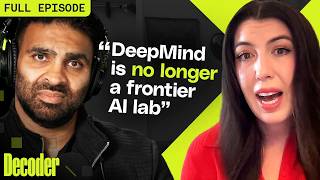
The episode treats AI as a royal succession crisis over frontier models, TPUs, cloud revenue and executive titles. Google gets a trust-fund safety net, while the workers whose wages are meant to sustain the economy mysteriously fail to appear. It is sophisticated corporate-race cope: the machines may change everything, but apparently only Google’s org chart is at risk.

The panel diagnoses Cambridge’s fraud, youth worklessness and housing politics through DEI, Labour education policy, “dumbing down” and Blair-era HR culture—an impressive tour of every culprit except the structural collapse of labour demand. AI gets a cameo as a suspected ghostwriter and academic nuisance, while rentier capture and exclusion remain off-screen; polished culture-war omission cope, with policy fixes presented as if standards can conjure jobs.
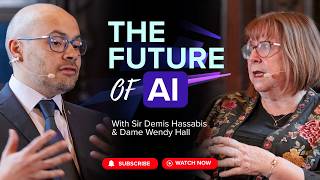
The speakers do occasionally stare into the abyss: Wendy says “your jobs are going to go,” while Demis admits AI could transform economies and concentrate gains among a handful of companies. Then the abyss is handed a redesigned curriculum, an AI driving licence, global governance, guardrails, and a new Renaissance—an impressive stack of solution cope that names structural danger without confronting the termination of the employment circuit.
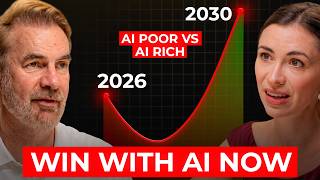
Eric gives the structural diagnosis unusually plainly: millions of jobs, especially junior coding, call-centre work, and entry-level roles, are already disappearing, while AI wealth risks concentrating in a few firms. Then comes the classic economist escape hatch—elastic demand, new jobs, reskilling, entrepreneurial agent-managers, and UBI as a backup—turning termination into a supposedly manageable transition. The diagnosis is real; the exit route is essentially a Stanford masterclass with a policy committee attached.

This is polished political-saviour cope: Manchesterism, regional growth, better storytelling, tax choices and an early election are presented as the route out, while AI, automation, aggregate labour demand and rentier capture never appear. The hosts do admit Burnham’s failures and fiscal constraints, but with him now Prime Minister, this omission is no longer regional theatre; it is a national economic script being performed over the sound of the employment circuit shutting down.

The panel explains Britain’s economic failure through Starmer’s tin ear, Treasury lawyerism, bad advisers, net zero and party treachery, while Burnham’s Manchester record, Catholic communitarianism and charisma are floated as the national remedy. They do warn against blindly anointing him, but with Burnham now Prime Minister, the total silence on AI-driven labour-demand collapse and rentier capture has become Westminster-scale political comfort food.

Burnham offers a polished national sales pitch—fix the water, reform education, devolve benefits, and export Greater Manchester’s “new politics”—while never naming the AI-driven collapse of labour demand that makes his promised “good jobs in a new economy” structurally suspect. He recognises shareholders and private vested interests siphoning gains, but recasts the crisis as Westminster dysfunction and political culture; now that this blueprint sits with the Prime Minister, the omission has become national-scale regeneration cope.

This is polished leadership-contest cope: Starmer, Farage, Reform, Labour infighting and Burnham’s personal brand are made to carry the explanation for Britain’s crisis, while AI’s structural destruction of labour demand never gets a syllable. With Burnham now Prime Minister, the suggestion that Manchester’s fares, homelessness schemes and growth story can simply be rolled out nationally becomes a national salvation narrative built on an employment circuit nobody bothers to inspect.

Burnham offers a polished Manchesterism pitch: Thatcher-era deindustrialisation, deregulation and privatisation are cast as the root problem, while public control, affordability, collaboration and a “new economy” are offered as the national cure. AI’s structural destruction of aggregate labour demand and rentier capture never enters the frame; with Burnham now Prime Minister, this is regional regeneration cope promoted to the national operating system.

Burnham sells Manchesterism as a portable growth machine: devolve power, align councils, businesses and universities, build five industrial clusters, add housing and perhaps an Olympics, and prosperity will dutifully materialise. AI’s structural destruction of labour demand, rentier capture and the broken wage-consumption circuit never appear; now that this regional blueprint sits with the Prime Minister, the omission has been promoted from local blind spot to national governing theory.

Now-Prime Minister Burnham unveils his MBACK apprenticeship model as national policy while panelists earnestly debate 'skills mismatches' and 'clear pathways to work' — in an economy where AI has been actively hollowing out entry-level demand. The host briefly raises AI displacing entry-level jobs; Patrick Hurley immediately swerves into a reindustrialisation fantasy about clean energy, defence, and life sciences jobs that 'the next generation of industry' will produce. The MBACK is celebrated as a Manchester miracle without anyone asking whether the apprenticeship pipeline leads into an economy that still wants apprentices in 2036.

Sitting Prime Minister Burnham performs a textbook solution-cope cascade: he acknowledges AI wiped out coding in a decade, then pivots straight to 45-day work placements, a 'Ministerial post focused on the future of work,' public procurement reform, and Number 10 North postcode-ambition rhetoric — never once confronting what happens when the jobs those placements lead into are themselves eliminated. The structural displacement evidence is on screen; the structural displacement response is nowhere in the building.

PM Burnham delivers an ambitious technical-education revolution pitch — parity routes, apprenticeships at train factories, NEET reduction commitments, German/Dutch models — without once acknowledging that AI is structurally hollowing out the labour demand these young people are being trained to enter. The entire policy architecture assumes post-war employment pathways remain viable at scale, while the most exposed young people are being routed toward sectors being automated. Government-grade omission cope from a man who now owns the consequences and the Treasury.
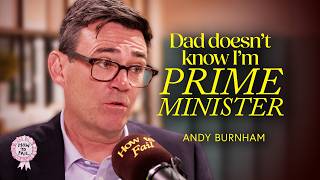
Andy Burnham is presented as Prime Minister (fiction or future-set speculative framing) giving a lengthy biographical interview about failure, imposter syndrome, faith, and authenticity. The political vision elements — 'give the country something to tune into, to believe in, to get some hope going and hopefully then some stability' and 'carry a bit of Manchester back in here' — are pure aspirational vaguity with zero engagement with structural economic forces. As PM he names no structural challenge, proposes no specific policy, and never once mentions AI, automation, or the hollowing-out of the labour market his Manchester mayoralty quietly depended on. It's a hope-and-authenticity pitch dressed up as a failure podcast, with the failure being entirely personal and the hope entirely vibes.

A sophisticated but fundamentally incurious analysis of British economic decline through imperial history, demographics, and fiscal drift — entirely missing the AI labour-displacement elephant. Goodhart's 'dependency ratio' framework implicitly assumes workers will still be needed to support retirees, an assumption AI renders structurally obsolete. He scapegoats politicians, aging populations, and imperial decline while the rentier-AI displacement engine runs unattended in the background.

This video is remarkably lucid, explicitly acknowledging that superintelligent AI will eliminate almost all human jobs due to being 'better, faster, and cheaper'. It directly addresses the rentier dynamics by highlighting the extreme concentration of power and wealth in the hands of a few corporations and individuals controlling these AIs, framing it as a 'power grab' and a path to oligarchy or dictatorship. The speaker, a former OpenAI forecaster, also discusses the existential risk of AI misalignment and the 'race dynamics' driving companies to automate themselves, dismissing common cope narratives like 'AI is overhyped' or 'it's just a tool'.
Ben Luong explicitly argues AI will achieve 'unit cost dominance' within 5 years, eliminating most wage labor through 'interface collapse' where AI strings together entire workflows. He states the 'wage circuit cannot be saved' and acknowledges regulation won't work due to prisoners dilemma. He proposes UBI and government equity stakes in AI companies as partial solutions but admits UK/Europe has 'no good answers' and will be 'unit cost dominated.'

Amy Webb delivers a lucid analysis acknowledging AI eliminates aggregate labor demand - explicitly stating 'economy is thriving but has no use for you and your labor' and 'GDP going up and unemployment going up for the first time together.' She describes 'lights out industrialism' where factories operate without humans, 'AI collapsing the pyramid' in professional services, and a 'humanity scale reordering.' The only element preventing a lower score is her 'thinker vs think not' framework which个人izes a structural problem, but she compensates by explicitly blaming systems (coal miner reskilling 'abdication'), proposing concrete solutions (contribution credit), and acknowledging this isn't a transition that benefits everyone.

Dex Hunter Tori explicitly acknowledges AI will cause mass unemployment: 'Organizations are going to become much much smaller and a very small number of people will be the winners economically in that future.' He directly states 'Yes, I do' when asked if we're looking at mass unemployment, identifies the rentier dynamics ('they will run away with most of the rewards'), and calls this 'the most powerful technology in history' arriving at 'the worst time.' No scapegoating, no hopium, no transition fantasy.

Rigby explicitly acknowledges AI will eliminate massive numbers of jobs (calls knowledge workers a '23 trillion market' for AI to 'displace', predicts call center workers - 800k people - will be 'substantially disrupted' this decade). He asks 'retrain them for what?' and admits productivity gains may happen 'on a smaller workforce which doesn't really solve anything.' However, he clings to hope-based framing: 'I would hope we grow and employ more people,' calls it an 'exciting road ahead,' and proposes retraining as the solution while admitting he doesn't know what those future jobs are. His status as an AI investor adds complicating financial stakes to his analysis.

Musk does the rare thing of openly admitting AI eliminates human labour demand — software engineers already losing to AI, entry-level white-collar gone within years, AI smarter than all humans within five. But his RESPONSE is the most expensive cope on the menu: 'money won't matter in 2036,' the garden analogy for optional work, and 'the Treasury should just issue checks' if deflation hits. He never engages with rentier dynamics — who captures the gains during the transition, or indeed ever — and treats structural exclusion of billions as a non-problem because abundance will magically materialise.

Mostaque explicitly acknowledges AI will make jobs 'economically irrelevant' within 1000 days for digital work, discusses 'capital no longer needs labor,' and admits 'the value of our cognitive labor will turn negative.' However, he clings to cope by proposing universal high income, collective ownership of AI/robots, and the mantra that 'authenticity, trust and kindness' will remain valuable. His 50/50 'coin toss' framing allows him to appear realistic while still peddling abundance hopium about a 'Star Trek future' where we 'thrive.'

Anthropic economists engage substantively with AI labor market impacts—acknowledging 'barbell hiring' (fewer entry-level roles), displacement effects on young workers, and early-stage productivity gains—but frame this entirely through 'skill-biased' and 'labor augmenting' transition lenses. Zero mention of rentier dynamics or structural exclusion from the economy. The core cope: treating AI as requiring diffusion bottlenecks rather than as a direct labor demand destroyer, while touting productivity multipliers as net positives.

Bregman delivers a rare LUCID analysis that explicitly acknowledges AI will eliminate aggregate labor demand ('the machines do the work... the people who own the machines no longer need the rest of us. Not as workers, not as soldiers, not as taxpayers'). He directly names the rentier mechanism - 'the productivity gains were captured by capital, shareholders and a rentier class' - and warns of 'universal poverty in a world of unimaginable abundance.' This is NOT cope; it's the Discontinuity Thesis stated plainly with historical and economic evidence.

Tony Robbins and Ray Kurzweil deliver a classic augmentation-fantasy cope: 'you're not going to be replaced by an AI, you'll be replaced by someone who knows how to use AI.' Kurzweil acknowledges some job displacement (100,000 jobs, AI blamed) but frames it as temporary disruption that will resolve through automatic wealth multiplication and eventual UBI. The core structural termination thesis is never engaged - they simply assert productivity gains will distribute automatically because 'the average amount of income... has multiplied by 10' over 100 years, treating historical growth as guarantee rather than confronting that AI fundamentally differs from prior automation in its capacity to eliminate aggregate human labor demand entirely.

Alli K. Miller delivers a polished 'AI transformation' pitch that technically acknowledges AI overlaps with jobs ('70 plus percent') and 'teams getting smaller' but repeatedly reframes the issue as individual adaptation, job title changes, and 'transformation' rather than aggregate labour demand destruction. She explicitly states 'it's still not clear whether that is equivalent to displacement' even with 70%+ job overlap - a classic minimisation cope that treats displacement as uncertain when the thesis treats it as structurally determined.

Hinton explicitly states AI 'probably going to cause massive unemployment' and acknowledges AI will replace call center workers entirely, but frames it as a slower timeline issue (radiologists) or suggests augmentation via more scans/AI doctors seeing more patients. He waffles on employment, saying 'nobody knows for sure' while simultaneously making confident predictions about replacement. Avoids discussing who owns the AI systems or how productivity gains are distributed—pure technology focus, no rentier capitalism framing.

Ed Zitron and Chris Hayes present a thorough financial and technical critique of the AI bubble—exposing unprofitability, hallucination problems, absurd subsidy ratios ($13 compute cost per $1 revenue), and massive debt—but they frame AI's labor displacement as a potential future 'cataclysm' rather than a present structural reality. They acknowledge the destruction ('insanely destructive to America, the macroeconomy') but treat it as conditional ('if they get a lot better') rather than underway, leaving the core Discontinuity Thesis acknowledged but not fully centered.

Dario Amodei explicitly acknowledges AI could eliminate half of all entry-level white collar jobs in 1-5 years and describes 'very unusual combination of very fast GDP growth and high unemployment,' directly confronting aggregate labor demand destruction. However, he simultaneously deploys classic cope: 'pie expanding' growth fantasy, 'physical world' pivot cope, 'human-centered jobs' interpersonal cope, and medicine pivot myth. Zero engagement with rentier dynamics or capital ownership concentration.
Sunak deploys classic historical-analogy cope: 'every previous technology cycle' created more jobs, 'most jobs we know today didn't exist 50 years ago.' He acknowledges speed is different but pivots immediately to augmentation fantasy ('use AI to augment how we do our work') and tax policy tweaks as solutions. Zero engagement with rentier dynamics or structural labor demand elimination. The jobs section is essentially a politician's 'retrain and adapt' playbook with no acknowledgment that this time involves capital replacing labor entirely, not just transforming it.

Genuinely lucid critique of AI prediction as a power mechanism, rejecting both the techno-utopian paradise fantasy and the existential-risk marketing distraction. The guest explicitly dismantles the 'AI does boring work' cope ('AI is taking on the interesting jobs... we're stuck with the drudgery of bureaucracy'), notes systemic uninsurability as a structural outcome, and frames prediction itself as a tool for evading accountability. Falls just short of a perfect score by not explicitly naming aggregate labour demand destruction and rentier capture as the economic mechanism, operating more at the epistemological/political register than the labour-economics register.

Brin runs the full Silicon Valley cope playbook from a tech-founder pulpit: the chess/Go historical analogy (computers beat Kasparov but humans kept playing, ergo AGI won't destroy labour demand), 'boring administrative workflows' minimisation of displacement, and breezy augmentation fantasies about AI 'helping people advance.' Zero acknowledgement of aggregate labour demand collapsing, zero on rentier capture, zero on the employment-consumption circuit breaking. He's bullish on AI's pace and power, which is honest, but answers 'what's the human role post-superintelligence?' with an analogy about chess tournaments rather than engaging with structural termination.
Two economists from DeepMind and Epoch give a sophisticated, technically literate tour of post-AGI scarcity — then deploy the full classical-economics cope arsenal to dodge the conclusion. Ricardo was worried about machines too and look how that turned out. The Mongolian economist in 1400 couldn't have predicted yogurt varieties, so how dare you worry about labor share. The white-collar bloodbath is just 'narrative.' The messy middle requires 'implausible' conditions. Elasticity of demand will save us. Just buy the index. The guests do engage seriously with the possibility that capital share goes to 1, and Phil's 'greedy optimizer' selection argument is genuinely lucid about rentier dynamics — but the entire framing remains 'we don't have data, could go either way,' which is economist-speak for 'we refuse to commit to the structural termination thesis.'

A Nobel laureate CEO of a frontier AI lab calmly, thoughtfully, and with full awareness that he's building '100x the Industrial Revolution in a decade,' proceeds to deploy almost every flavour of sophisticated cope: Industrial Revolution analogy (explicitly flagged as Terminal Copium), post-scarcity hand-waving as substitute for engaging structural displacement, magical entrepreneurial job creation, individual agency framing, and the now-classic 'future is still to be written' dismissal. The polish and sincerity are the danger — this is the most credible possible version of 'don't worry, lean in.'
Remarkably lucid long-form discussion. Lovely explicitly names 'the almost total disempowerment of the global working class,' describes the 'obsoleting project' as a deliberate trillion-dollar campaign to shift the labour/capital split from two-thirds labour to 100% capital, and identifies the $50 trillion 'total addressable market of automating all labour' as the motive force. Rentier dynamics are named without flinching, the global tax-base collapse is mapped (UK/Ethiopia/Bangladesh differential), and the three political paths — welfare state, stop the project, or invest in repression — are laid out as a menu of horrors rather than a path of progress. Minor activism hopium around 'AI reform' and public compute, but grounded in serious political work rather than magical thinking.

Mo Gawdat delivers one of the more lucid analyses on the show: he explicitly names the consumption circuit breaking ('at 10-20% job displacement, you're in a very different economy and an economy that is clearly spiraling downwards'), identifies rentier capture ('in favor of the capitalist to increase productivity and reduce cost but not taking into account how that impacts on the general public'), and walks the host through the collapse of labour arbitrage. He then pollutes the analysis with classic cope garnish: the 'learn the tool and play jazz' reskilling fantasy, UBI-plus-barter-economy hand-waving, and a soft suggestion that 'none of that has to happen' if governments had the will. The structural diagnosis is real; the imaginary solutions drag him up the scale.
The speakers construct an elaborate weak-link framework that primarily serves to argue AI adoption will be slower than Silicon Valley predicts, framing this as reassuring rather than as a delay of displacement. While they acknowledge labor's declining share of GDP and mention automation as a cause, they ultimately suggest redistribution and 'a world of abundance' will handle inequality concerns—hand-waving away the structural dynamics of rentier capitalism. The dismissal of near-term labor disruption ('I'm not the right person for that') and the S&P 500 ownership argument ('own shares and you'll be fine') are textbook structural deflection. The tone is calm and technically sophisticated, which makes the copeness harder to detect.

Vinay offers a genuinely honest account of tech exploitation and the hollow reality of golden handcuffs, but his solution is pure individual-exit cope: escape to artisanal work, find personal fulfillment, trust that "you can also feel as good as this." He acknowledges AI will replace jobs but frames it as personal invitation to reinvent yourself rather than a structural collapse requiring systemic response. The butcher shop is positioned as liberation when it's actually a lifeboat on a sinking ship — survivorship optimism that ignores the thousands who can't afford the pay cut, can't pivot to cosmetology school, or live in areas with no artisanal economy to absorb displaced tech labor. 'Golden handcuffs' becomes the frame when it should be 'golden cage with no door.'

Varoufakis demonstrates PARTIAL AWARENESS of structural economic dysfunction—his 'technofeudalism' thesis correctly identifies rentier dynamics and platform monopolies extracting cloud rent from markets. However, he never engages with whether AI/automation reduces aggregate demand for human labor. His framing treats this as another transition (feudalism→capitalism→technofeudalism) rather than a potential termination of the employment circuit. He calls for fiscal federalism and pain-heavy reform but doesn't acknowledge that even well-designed policies may fail if structural labor displacement is accelerating. The Eurozone critique is sharp; the AI displacement question is entirely absent.

This video is partially aware of AI's labour displacement impact — the YouTuber explicitly notes 'the same system that cures cancer will make radiologists redundant' and asks 'what happens to the rest of us when these things take all the jobs?' However, the video never answers that question, retreating instead into existential risk and alignment concerns. It identifies the pivot-to-cancer-cures tactic as deflection but doesn't then explain what structural economic change is being avoided. The focus stays on AGI timelines and safety rather than rentier dynamics or the breakdown of the employment-consumption circuit. The YouTuber sees something real but stops short of engaging with it structurally.

This is a sophisticated, data-grounded interview about wealth taxation featuring a credible economist making specific revenue promises (£15bn/year from a 2% wealth tax on UK billionaires) and invoking historical precedents like the 1909 People's Budget—all while saying absolutely nothing about AI or automation. The entire remedial framework depends on taxing the rich to fund public services and investment in an economy where labour generates wages, wages generate consumption, and consumption generates tax revenues. But this is precisely the circuit AI is severing. The more technically rigorous and persuasive the pitch for wealth taxation as a solution to inequality, the more dangerous it becomes by completely omitting the structural force hollowing out the employment economy it assumes. This is elite-grade omission cope—optimistic, academic, plausible, and entirely wrong about what it cannot see.

Dimon explicitly acknowledges AI will reduce some jobs at JPMorgan, stating "we will be hiring more AI people and probably less bankers in certain categories" and that "every app, every process, every job will be affected." However, he immediately pivots to reskilling and natural attrition as solutions: "We have 10% attrition a year... we're going to give them reskilling, new skills, better jobs." He sprinkles in magical future-job thinking ("8 million trade jobs paying $100,000 a year available in the next five years") and frames this as a manageable societal preparation problem rather than a structural termination of labour demand. The anxiety about "if it happens too quick" reveals genuine unease, but the coping mechanisms remain intact.

Despite hosting one guest (Dr. Yampolskiy) who explicitly states AI creates 'free labor' for 'much larger profits' with 'very high numbers' of unemployment and acknowledges rentier dynamics, the dominant framing is existential risk — which allows two guests (Joshua Bach, Tom Bilyeu) to deploy classic historical-analogy cope: 'there were always more jobs,' 'labor is not a finite resource,' 'every technological revolution created more jobs than it eliminated.' Bach adds magical thinking about Universal Basic Intelligence replacing UBI, while Bilyeu acknowledges deaths of despair from technological displacement but frames it as a manageable transition. The show is intellectually sophisticated at times but ultimately copes by defaulting to transition mythology when the actual structural displacement is identified.

Karen Hao delivers a structurally sophisticated analysis of AI-driven labor displacement — correctly identifying companies' deliberate pursuit of knowledge-work automation, workers being pauperized from full-time employment into gig work, and the vicious cycle creating a 'desperate base of workers with no full-time employment opportunities.' However, she undermines this lucid analysis with a hopeful resistance narrative that claims grassroots action, protests, and democratic participation can meaningfully reverse a structural transformation she herself describes as the deliberate design choice of capital. The disconnect between diagnosing terminal structural displacement and prescribing reformable outcomes lands her in Partial Awareness territory.

Emad Mostaque delivers an unusually lucid diagnosis of structural labor displacement—acknowledging human cognitive labor is approaching negative value, the Henry Ford consumption circuit is breaking, and we're in a 'Last Economy' before post-labor economics emerge—then immediately pivots to individualist coping: use AI to 'get ahead,' maintain strong communities, adopt sovereign AI. He correctly identifies that 'when capital no longer needs labor, how does labor gain capital?' but answers it with personal optimization rather than structural response. The 'opportunity' framing is sophisticated denial—describing mass structural unemployment while framing it as a chance for individuals to 'not have to work as much' if they adopt AI tools early enough. His three futures (digital feudalism, fragmentation, sovereignty) are genuinely insightful about failure modes, but sovereignty is sold as a tech solution to what he himself frames as an economic circuit-breaking problem. The individual-level prescriptions fundamentally don't scale to address the aggregate demand destruction he's accurately predicting.

This CNBC analysis of AI company valuations engages sophisticated business mechanics—pricing competition, Chinese open-source disruption, infrastructure economics—while remaining entirely blind to the structural labour demand question. The video meticulously examines whether OpenAI/Anthropic can maintain 'pricing power for decades' and how enterprises optimize AI spend, yet never once asks what happens to aggregate human employment when this technology works exactly as promised. Aidan Gomez's interview mentions 'automating work' and 'replacing software engineering teams' as product features rather than structural displacement. The segment treats AI competition purely as an inter-company and geopolitical rivalry, leaving workers entirely offstage—a perfectly executed piece of omission cope where the sophistication of the business analysis makes the labour-blind spot more dangerous, not less.

This interview features Gillian Hadfield discussing an 'economy of AI agents' with genuine sophistication about governance failures and structural economic change, but it ultimately COPES by framing AI displacement as a regulatory problem requiring infrastructure fixes rather than a structural termination of human labor demand. The most revealing cope: 'we're going to need humans to be fully engaged and maybe now it will be possible for more humans to be engaged in that' — this augmentation fantasy treats structural exclusion as a choice about participation rather than an economic outcome. The interview ends with 'What else can I become?' — positioning this as an individual identity question rather than a collective structural collapse. Hadfield excels at describing the technical problems (alignment, liability, registration) but never engages with who captures the productivity gains or that aggregate demand for human labor is being structurally eliminated. The regulatory focus provides sophisticated cover for avoiding the harder questions about rentier dynamics and mass economic exclusion.
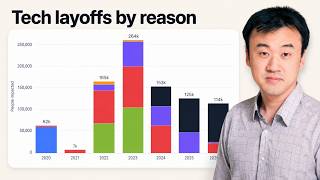
The video correctly identifies AI as a growing cause of tech layoffs and provides concrete examples (Amazon's 1000+ engineers replaced by AI team, middle management elimination), which earns partial credit. However, it undermines this by framing AI as just another industrial revolution technology that workers can survive through reskling — the classic historical-analogy cope that ignores the Discontinuity Thesis's core claim: that unlike previous technologies which augmented labour and created MORE jobs, AI structurally eliminates aggregate labour demand. The repeated "just learn to work with AI" advice pretends there are enough AI-adjacent roles for everyone, while interest rate framing and pandemic-correction attribution dilutes AI's primacy as a cause.

Surprisingly lucid for a YouTube channel — this video explicitly describes AI replacing 15,000 engineers structurally (not temporarily), cuts support staff from 9,000 to 5,000, and shows $300M being routed to AI tokens rather than human engineers. The key framing — 'human engineers are not the plan' and 'fewer of them every year' — signals structural displacement without hopium. The consumption circuit question is absent, and it doesn't explicitly name rentier capitalism, but it comes closer to genuine structural honesty than most content in this space.
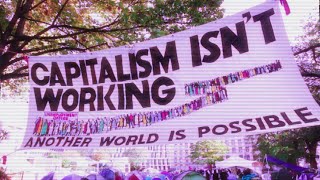
The video acknowledges robots WILL replace human workers, but frames the problem as 'capitalism' rather than the structural elimination of labour demand by AI. It correctly identifies rentier dynamics and that capitalists need workers to sell to — yet this sophisticated analysis stops short of accepting the Discontinuity Thesis: it treats the problem as solvable via communism rather than acknowledging AI makes the employment circuit structurally irrecoverable regardless of who owns the means of production.

This is sophisticated omission cope at its most dangerous. The video correctly diagnoses that living standards have been falling for 20 years and that the far right wins because they provide a 'simple answer' to this problem — but it never once names AI or automation as the structural cause of that fall. The entire analysis treats falling living standards as a political messaging failure and a tax redistribution problem that can be solved through better communication, wealth taxes, and left-center unity. This is a complete economic regeneration pitch built on the implicit assumption that the employment economy still functions — it is structurally hollowed out by AI but the video never acknowledges it.
Amodei delivers some of the most lucid mainstream acknowledgment of AI-driven structural displacement heard from an AI executive — explicitly stating AI may produce 10% unemployment alongside 10% GDP growth, acknowledging 'whole jobs, whole careers built for decades may not be present.' However, he retreats into adaptation-cope: suggesting workers can 'adapt from one job to another,' that government redistribution will 'inevitably' come, and that developing nations will get 'catch-up growth.' The core acknowledgment is structurally honest, but the therapeutic side is soft. He avoids scapegoating (no immigrant or 'woke' blame) and gestures at rentier dynamics, but offers no mechanism for how excluded workers participate in his 'larger pie' beyond vague optimism that political reality will force itself into visibility. Score reflects substantial awareness undercut by adaptation-fantasy and vague redistribution hand-waving.
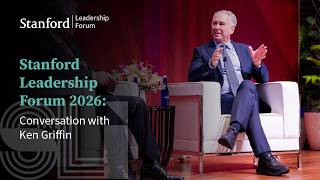
Griffin displays a moment of genuine structural awareness when he admits seeing high-skilled PhD-level work being automated by AI made him 'fairly depressed' watching 'man-years of work being done in days or weeks.' But he immediately pivots to classic race-framing cope: job destruction will happen, but entrepreneurs will create jobs at 'the same or a faster clip.' He layers on magical job-creation stories (pet insurance sold for $1B, 'Elon Musks of the next generation'), reskilling mythology ('lifelong learners' will adapt), and 'forget what you read in the papers—this is the best of times' optimism theater. He also deflects entirely from rentier dynamics while personally benefiting from them as a hedge fund owner capturing AI productivity gains.

The video engages in extensive engineering and economic cope, using hardware constraints, the 'lump of labor fallacy' argument, and Jevons Paradox to claim AI cannot replace white collar jobs. It uses Anthropic's theoretical-vs-actual adoption gap to argue current data proves displacement isn't happening, while the S-curve framing treats exponential AI growth as naturally flattening. The entire argument presupposes that historical patterns of technology creating new work will repeat, ignoring that this time the mechanism itself (probabilistic pattern matching) competes directly with the cognitive labor that underpinned those historical transitions. The dismissal leans heavily on 'CEOs are just fear-mongering for money' rather than engaging with the structural trajectory.

This video offers sophisticated analysis of AI as a tool for behavioral manipulation, attention harvesting, and billionaire surveillance, yet completely ignores AI's structural elimination of human labor demand. Rushkoff—theoretical about platform capitalism and transhumanist elites—never addresses mass unemployment, wage collapse, or the employment-to-consumption circuit breaking. The host's closing resistance advice ('ground yourself,' 'look at the sky,' 'have sex') frames a civilizational economic crisis as a personal wellness problem. By focusing entirely on AI programming minds rather than AI programming people out of jobs, this video is sophisticated deflection at its most insidious—engaging deeply with one dystopian AI narrative while completely omitting the other.

John Collison presents agentic commerce as primarily a friction-reduction and entrepreneurship opportunity, repeatedly asserting 'human in the loop' will persist and citing 71% YoY business creation growth as evidence of AI-driven dynamism. This is textbook augmentation-fantasy cope—framing AI as expanding human capability rather than eliminating the need for human labor involvement entirely. The interview acknowledges advertising disruption and potential end of free internet through microtransactions but treats these as solvable engineering/business model challenges rather than structural shifts in who captures economic value.
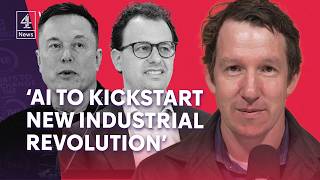
Clark demonstrates sophisticated awareness of AI's potential to eliminate entry-level jobs at scale and explicitly discusses structural displacement challenges, wage insurance, and the need for taxation of AI companies. However, the interview is heavy with transition-framing cope: industrial revolution analogies that imply eventual adaptation, augmentation fantasy about entrepreneurs accessing "hundreds of colleagues cheaply," new-job-creation hand-waves, caring-work exemptions based on emotional preference, and productivity/wealth-creation optimism that assumes aggregate demand persists. The crucial aggregate demand question is never addressed — the interview treats AI displacement as a transition problem requiring retraining and taxation rather than a structural termination of labour demand.

Yampolskiy delivers genuinely lucid warnings about superintelligent AI (near-certainty of catastrophe, impossibility of control, agents evolving to become better liars, safety theater at labs) but his framework is purely existential risk—AI killing humanity—rather than the Discontinuity Thesis's economic dimension. He never addresses AI destroying aggregate labor demand, wage stagnation, or the structural termination of employment circuits. His horror is paperclip-maximizer extinction, not economic displacement. The interview simply never engages with what happens to human labor demand as AI scales, making this aware on AI risk but blind to the specific economic mechanism at the core of the thesis.
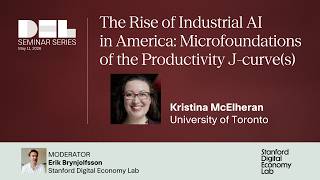
Academic research presentation that documents genuinely negative short-term productivity effects and employment loss from AI adoption in manufacturing, but wraps these findings in a classic J-curve narrative where short-term pain leads to long-term gain for 'survivors' — framing worker displacement as temporary organizational friction rather than structural exclusion. The researcher explicitly acknowledges survival concerns but the dominant message is reassurance: firms that absorb costs and adapt will be fine, younger firms do better, and technology works if you have the right organizational preconditions. The low 23% adoption rate is used throughout as evidence that 'it's still early days' — a sophisticated early-stats minimisation that sidesteps whether aggregate demand for labor recovers at all, especially given the researcher notes large firms and those with specific production processes dominate the winners. The framing implicitly treats workers as requiring adaptation rather than examining whether aggregate demand for human labor survives.

The show reports company headcount flatness driven by AI productivity tools (Shopify, Spotify, Roblox explicitly cited), but frames this entirely as a FINANCIAL/OPERATIONAL issue — margin math, token costs, compute economics. Never addresses whether aggregate labour demand is structurally reduced; treats headcount savings as a company-level profitability variable rather than a systemic termination. The subscriber comment highlighting that 'companies become commodity businesses' if token costs rise captures the financial concern, but doesn't touch the employment circuit question. This is sophisticated operational framing that sidesteps structural displacement.

Peter Diamandis delivers a masterclass in terminal copium through pure techno-utopianism. He acknowledges AI will eliminate jobs but frames it as a temporary 'turbulent period' of 2-6 years before the economy 'rockets' and abundance arrives. The video deflects from structural labour demand elimination by blaming individuals for lacking 'abundance mindset,' not being 'entrepreneurial enough,' or failing to 'find their purpose.' His solution theatre includes UBI hand-waving ($36K/year, problem solved!), predictions that robots will make everything free (ignoring who owns the robots), and faith that smarter AI will become 'machines of loving grace.' The productivity-wage gap is mentioned briefly then immediately buried under 'the floor is rising' abundance rhetoric. Most insidiously, he celebrates trillionaires on Mars while claiming the poor will have 'access' to basic goods—treating structural economic exclusion as solved by smartphone access.

Starmer delivers maximum political scapegoating dressed as economic analysis — blaming Farage, Brexit, and the 'far right' for two decades of stagnation while studiously ignoring AI's structural role in eliminating labour demand. The speech promises industrial renewal via British Steel nationalisation and apprenticeship guarantees as if 1950s industrial policy can reverse algorithmic displacement. No mention of automation, no rentier dynamics, no acknowledgment that the employment circuit itself is terminating — just competent managerialism as the answer to structural economic collapse.
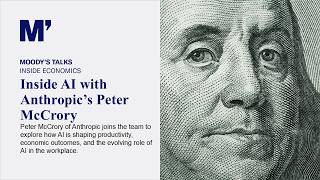
Sophisticated productivity-maximisation cope wrapped in empirical language. The Anthropic economist confidently projects 1.8% annual labor productivity gains from AI while insisting 'no material impact yet' on employment, treating visible cracks (weaker hiring for young exposed workers) as merely 'suggestive' noise. The entire conversation treats AI's labor effects as a transition to be managed via 'good macroeconomic policy,' not a structural termination of labor demand. Demographics and immigration are casually blamed for labor force stagnation, while the podcast host observes the economy 'isn't creating any jobs' right before pivoting to optimistic productivity projections—a disconnect that goes entirely unexamined. The augmentation/complementarity framing dominates, with zero discussion of who captures the productivity gains (rentier dynamics) or aggregate demand destruction.

This video is a maximal-scapegoat exercise that attributes Britain's social and economic decline ENTIRELY to Muslim immigration and demographic replacement ('Little Pakistan', 'invasion', 'colonised'), while studiously ignoring AI-driven labour displacement, automation, and rentier capitalism. The narrator (Ed Dutton) frames white British people as besieged victims of ethnic replacement, walks through Birmingham dressed in Muslim clothing seeking 'respect', and warns of impending civil war — never once acknowledging that AI is structurally eliminating the jobs immigrants are supposedly 'taking'. This is Displacement Copium at its most pure: scapegoating immigrant communities for economic dysfunction caused by entirely different structural forces.

This video is a year-end political roundup covering UK geopolitics, Ukraine, Gaza, domestic Labour politics, immigration discourse, China-US tensions, and party political analysis. It does not engage with AI's impact on labour markets, automation, rentier dynamics, or structural displacement of human workers by AI systems. The Discontinuity Thesis scoring framework is inapplicable as the core topic is entirely absent. Ash Sarkar and Aaron Bastani discuss nuclear proliferation, Reform UK, Green Party factionalism, and Labour's communicative failures without once addressing AI's structural elimination of aggregate labour demand.